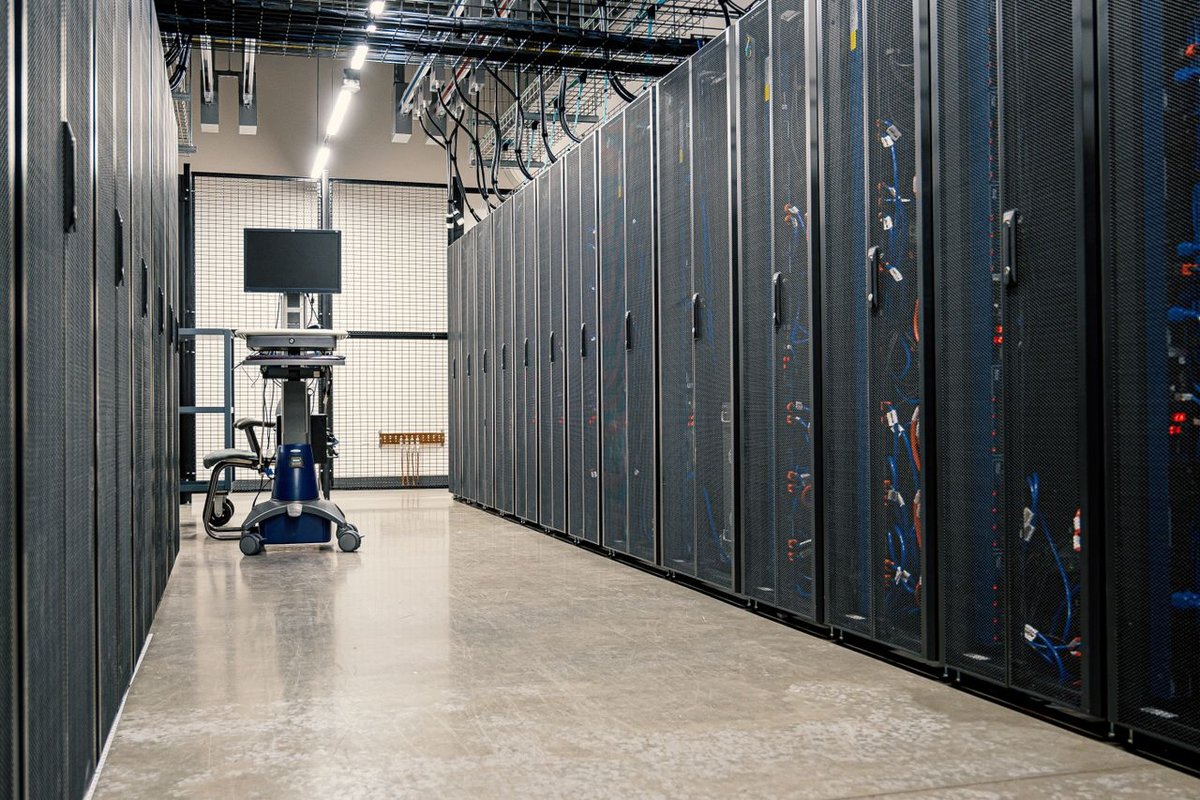
October 16, 2026 — The first 1,024-NPU Atlas 950 SuperPoD was powered on this week, and it came online with a 0-day adaptation of StepFun's Step 5 Preview model. This is the largest supernode deployment publicly documented to date: 1,024 Ascend 950 NPUs in one cluster, liquid-cooled end to end, addressed as a single machine.
For two years, the debate about domestic AI chips has focused on per-chip performance. Trillion-parameter models changed the question. A cluster of 1,024 fast chips is useless if they spend most of their time waiting for data to cross switches. The engineering problem is not "how fast is one card" but "can a thousand cards behave like one."
1. The numbers
| Metric | Figure | What it means |
|---|---|---|
| NPUs per cluster | 1,024 Ascend 950 | The largest publicly documented domestic supernode deployment |
| FP8 compute | 1 EFLOPS | 10^18 operations per second, aimed at trillion-parameter training and inference |
| FP4 compute | 2 EFLOPS | Double throughput at lower precision, suited to high-concurrency inference |
| Global unified memory | 256TB | NPU memory is addressed as one pool; models do not have to be split per card |
| Interconnect | TB/s class | Close to on-package bandwidth, reducing the communication wall |
| End-to-end latency | 3μs | Direct cross-card access without protocol conversion or switch hops |
| Cooling | Full liquid cooling | Compute and interconnect racks are liquid-cooled |
| Fabric | UnifiedBus (Lingqu) | Huawei's interconnect, designed to scale to 8,192 NPUs |
2. Why a SuperPoD is not just a rack of GPUs
A conventional AI cluster is built from 8-GPU servers connected by InfiniBand or Ethernet through multiple layers of switches. When a model is split across cards, tensor parallelism generates frequent all-reduce traffic. Every cross-server exchange pays a latency penalty, and the penalty grows with cluster size.
A SuperPoD replaces the network with a bus. NPUs address each other directly, memory is globally addressed, and the cluster behaves like one machine. Huawei's UnifiedBus is the key piece: it is what allows 1,024 cards to communicate at TB/s with 3μs end-to-end latency instead of going through a stack of switches.
The hard part is not filling a rack with cards. It is three things:
- The interconnect. Topology, routing and congestion control at 1,024 nodes. Get any of them wrong and adding cards stops adding performance.
- Power and cooling. A rack at this density is a hundred-kilowatt-class load. Air cooling cannot keep up; liquid cooling, CDUs, leak detection and floor loading all have to be designed together.
- The software stack. The 0-day adaptation of Step 5 Preview suggests work at the operator, communication and scheduler layers. Without that, the cluster's theoretical FLOPS never reach the model.
3. Why 1,024 is a threshold
1,024 is not an arbitrary number. It is roughly the entry point for a "thousand-card" training cluster:
- Trillion-parameter models: the weights no longer fit on one card, so tensor and pipeline parallelism become mandatory. More cards mean more communication, which is exactly what a low-latency fabric is for.
- Long context and multimodality: million-token contexts and image/video inputs multiply memory and bandwidth requirements.
- High-concurrency inference: agent workloads are fragmented and bursty. FP4 throughput matters more than FP16 peak.
4. Build, rent or hybrid
| Model | Who it suits | Reality check |
|---|---|---|
| Build your own SuperPoD | Hyperscalers, national and industry AI centers | Hundreds of millions of RMB, liquid-cooled halls, specialist operations, power quota |
| Rent capacity | Most SMEs and university labs | Pay per card-hour or per token; no capex, but check data residency and compliance |
| Hybrid | Companies with steady inference demand | Small local cluster for core workloads; burst training in the cloud |
For manufacturers, trading companies and public-sector buyers in the Pearl River Delta, the practical question is not "should we own 1,024 cards" but "what do we need the model to do." Document Q&A, visual inspection and customer-service assistance usually need one to four inference cards. Fine-tuning an industry model is better rented by the thousand-card-hour than owned.
5. Liquid cooling is the entry ticket
The SuperPoD ships with full liquid cooling, which changes what a machine room must provide:
- Floor loading. A fully populated liquid-cooled rack weighs far more than an air-cooled one. Older buildings need a structural check.
- Power distribution. Hundred-kilowatt racks need dedicated circuits, busway or busbar. Standard PDUs will not do.
- Piping and leak detection. Quick connectors, manifolds and CDUs are the weak points. Leak sensors must cover every joint.
- Operations. Water quality, flow rate, pressure and air purging require new procedures. "Check the fans" is no longer enough.
6. A reality check
Lighting up 1,024 NPUs is an engineering milestone, not proof that domestic chips have caught up across the board. Per-chip efficiency, the CUDA software moat, model coverage and long-term cluster stability still need real workloads to prove. Buyers should insist on a proof of concept on their own data rather than choosing a platform because of a headline number.