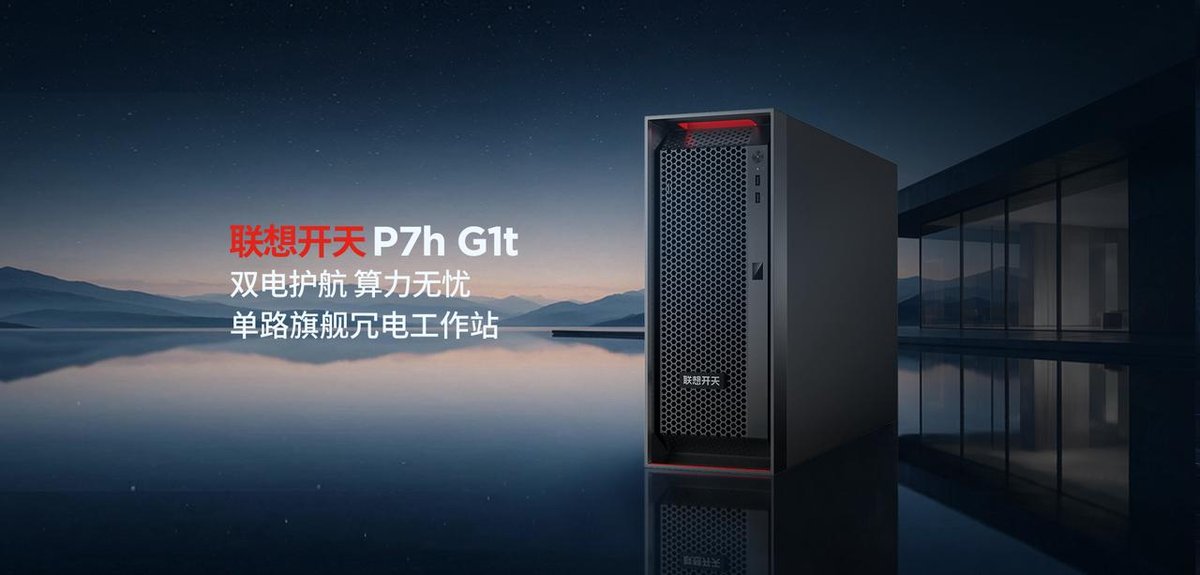
October 22-23, 2026: Lenovo Kaitian launched the P7h G1t workstation, and the number to start with is 1+1. One CPU socket, two CRPS power supplies rated at 550W/1200W, both online at the same time, both hot-swappable. Lenovo calls it the first single-socket flagship redundant-power workstation in China's domestic-IT (Xinchuang) market, and the label is the least interesting part. The interesting part is that redundancy now fits a platform a small site can budget for.
That selling point is not glamorous. It happens to land on the sorest point in the power industry, and on the desks of the people in Guangzhou and across South China who equip those sites.
The power industry's dilemma
Grid planning runs on the N-1 principle: any single line or any single component can drop out of service and the system still has to keep working. Applied to a workstation, that means a failed power supply cannot take the machine down. Domestic-IT workstations have had a long gap here:
- Single-socket, single-PSU models: cheap, but the power supply is a single point of failure. Dispatch monitoring and substation control run 24/7, and neither can accept a single supply.
- Dual-socket redundant models: reliable, but the compute is more than the job needs and the price is high, so deploying them in volume gets expensive quickly.
The P7h G1t's approach is to keep the single-socket architecture to hold down cost, add dual power supplies, and fill the space in between with "single socket plus two supplies."
For a buyer in Guangzhou, the requirement is usually fixed; what moves is the platform cost.
How the redundant supply works
The machine supports 550W/1200W 1+1 CRPS redundant power supplies. Both units are online at once and split the load evenly. If either one fails, the other takes over with no break and the output does not waver. The failed unit can be pulled and replaced while the system keeps running, and once the new module is seated, 1+1 is restored.
What separates 1+1 from simply having two supplies is the sharing. A box that carries a spare only switches at the moment of failure, and the switch is where glitches live. Two supplies that are both live and both carrying current mean a failure is absorbed rather than felt: the surviving unit picks up the other half of the load, and nothing downstream sees a gap.
For a job where a power cut is an incident, that difference is not a spec sheet line. It is business continuity. A dispatcher does not fly blind because someone is swapping a power supply, and a control-room host does not go dark because a module failed.
Configuration: single socket does not mean stripped down
The core is a Hygon C86-4G processor. Take the mainstream model in that family: 16 cores and 32 threads, 2.8GHz, 32MB of L3 cache, native x86 ecosystem compatibility, and a built-in cryptographic coprocessor that supports the Chinese national cryptographic algorithms. It has already passed the security and reliability evaluation. For dispatch monitoring and data acquisition, that is enough.
| Item | Specification |
|---|---|
| Processor | Hygon C86-4G (mainstream model: 16 cores / 32 threads, 2.8GHz, 32MB L3) |
| Memory | 4 x DDR5 UDIMM, up to 128GB |
| Storage | 1 x M.2 NVMe SSD, up to 4 x 3.5-inch drives, RAID supported |
| Expansion | Full-height, full-length, dual-width GPU supported |
| Power | 550W/1200W CRPS 1+1 redundant, hot-swap |
| Reference price | Not announced; the sibling P3h G1t sells around RMB 7,200 |
The dual-width GPU support deserves its own note. Renewables simulation, digital twins, and inspection-image analysis in the power industry all need GPU compute, but machines in this class have tended to offer only low-profile or single-width slots. With a full-height, full-length, dual-width card, the P7h G1t merges a monitoring terminal and a light inference node into one box, so a site ends up powering, cooling, and patching one chassis instead of two.

Three takeaways
- Redundancy is moving down from servers to workstations. Dual power supplies used to be standard on servers and optional on workstations. Power, rail, and air traffic control will turn the option into a requirement, because those buyers cannot accept a single point of failure in a desk-side box.
- The value of a single-socket platform is being recalculated. If 16 cores is enough, there is no reason to pay twice the platform cost for dual socket. The budget saved can go to redundant supplies, RAID, and a GPU, which raises reliability instead of raw benchmark scores.
- Price is still the biggest variable. Lenovo has not announced P7h G1t pricing. Against the P3h G1t at around RMB 7,200, a flagship single-socket redundant-power model will most likely list higher. Volume buyers should total it up as "system plus five-year on-site service" rather than comparing box prices.
Who it fits, and how to sign off
- Grid dispatch, substation control, generation central control: the core scenarios, take these first.
- Energy central control, rail transit, civil aviation ATC: the same long-uptime requirement, and this configuration carries over directly.
- General office work: unnecessary. A single-supply model is enough, and dual power is waste.
At acceptance, run three tests: pull one power supply and watch whether the workload survives; replace a power module with the system running; and simulate a single-drive failure to confirm the array degrades and the data stays reachable. Once all three pass, "redundancy" has actually been verified rather than merely purchased.
For volume buyers, that list is also the cheapest insurance available. The parts are already in the box, and the only cost is scheduled time to prove them. Sites that skip the test tend to learn the second supply was dead on the day the first one failed, which is the exact scenario the whole design exists to prevent.