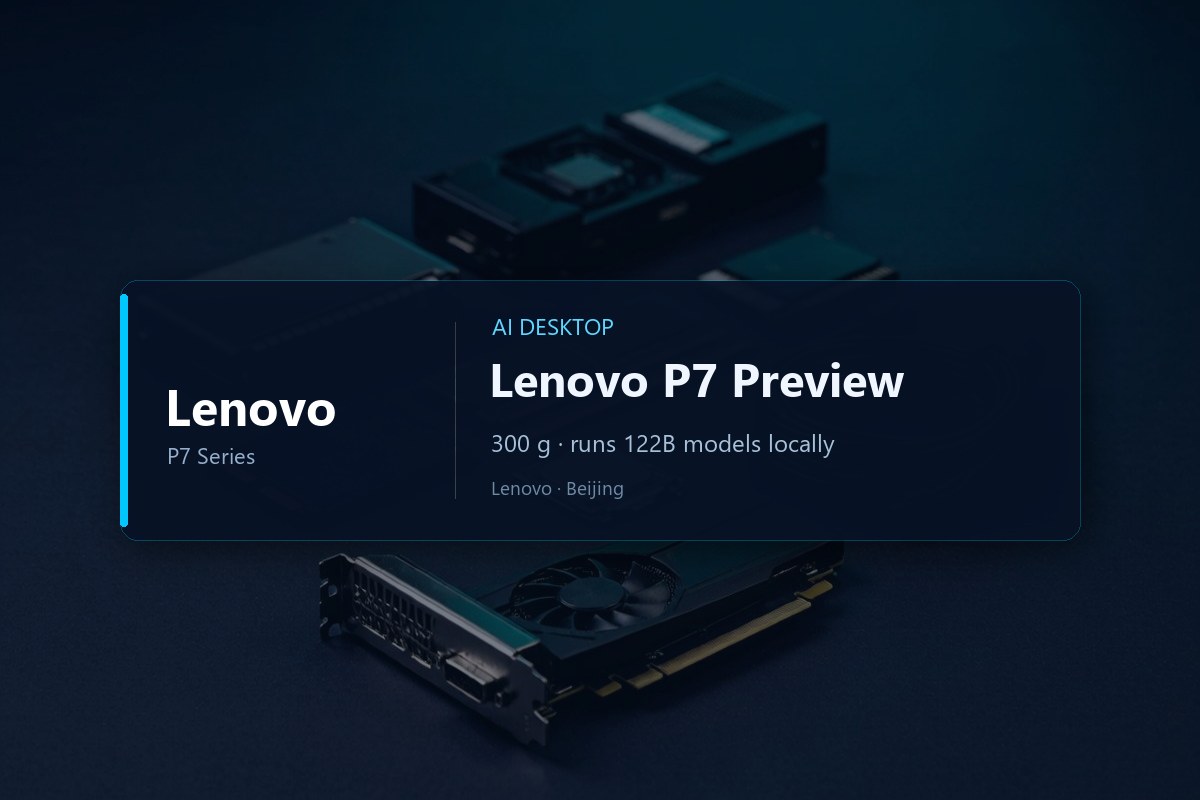
October 25, 2026 — Lenovo has shown a preview unit of its P7 AI desktop: a palm-sized, 300-gram box that draws under 30 W at full load, runs below 35 dBA, and still runs local models of up to 122B parameters with a 256K context window at 50 tokens per second offline. Two domestic chips split the work — one for AI inference, one for scheduling and system tasks; Lenovo has not named either. The pain points on the slide are refreshingly specific: cloud token bills that grow every month, privacy data that cannot leave the building, and pipelines that die when the network blinks.
30 watts running 122B is engineering, not magic
Set expectations correctly: this is not a workstation squeezed into a lunchbox. It is an inference terminal. Fitting 122B parameters into 30 W takes quantized models and inference-oriented silicon, and the trade is peak throughput. Fifty tokens per second serves one person's chat, documents and code completions; it will not carry a team's concurrent traffic. The point is keeping a personal AI assistant on the desk, running 24/7 without wincing at the power bill — at under 35 dBA, you won't hear it sitting at your desk.
The software stack is the actual product
The hardware is the shell. What P7 sells is a local-first stack: a bundled model library covering a general LLM, image generation, document recognition and speech-to-text, none of which call a cloud API; Lenovo's Tianxi AI assistant out of the box; user-configurable agents; and an Auto mode that routes by task complexity — trivial work runs locally for free, genuinely hard work spends cloud tokens. Lenovo's official line is "balancing quality and cost" — in plainer language, the meter only runs when it has to.
Published versus not
| Item | Status | Detail |
|---|---|---|
| Size / weight | Published | Palm-sized, 300 g, rated for 24/7 desk duty |
| Dual-chip design | Partly | Domestic inference + scheduling chips; models unnamed |
| Local model capability | Published | Up to 122B, 256K context, 50 tokens/s offline |
| Power / noise | Published | <30 W full load, <35 dBA |
| Software stack | Published | Local model library + Tianxi AI + agents + Auto local/cloud routing |
| Price / OS / ship date | Not published | Early-adopter program open; formal sale "soon" |
Three takeaways
- This treats token anxiety; it does not replace workstations. Lenovo's own lineup already splits the ground: the Kaitian × Baidu Dazi full-stack workstation for enterprises (our Oct 21 piece), the Kaitian P7h G1t redundant workstation for power grids, rail transit and similar industries (Oct 23), and now the P7 as a personal inference box for developers and light office work. A matrix, not an overlap.
- The counter-intuitive part: offline matters more than benchmark scores. The scenarios where this class of device is indispensable — intranets, classified documents, travel, weak networks — are exactly where cloud offerings are at their worst. For government, legal and finance document work, "data never leaves the machine" is the requirement, not a feature.
- The early-adopter program is a two-way filter. Lenovo gets real coding and office workloads; participants get influence and likely better terms. Companies should not be first-mover guinea pigs, but the queue is worth joining — the first cohort's field reports will say more than the launch deck.
A decision checklist
- Do the token math. If monthly API spend for your team already exceeds one high-end mini PC, local inference deserves a serious evaluation.
- Count your offline scenarios. Intranet-only offices, sensitive documents, demo machines on the road — hit two or more and this category was built for you.
- Check the model fits the job. A quantized 122B handles everyday documents, summaries and code completion; complex reasoning and heavy multimodal generation still need the cloud, and Auto mode assumes you accept that hybrid reality.
- Wait for three facts. Chip model (it decides ecosystem and driver longevity), price, and operating system. Decisions get easier when all three land.
- Apply to the early-adopter program if your team qualifies — validating on your real workload beats any spec sheet.