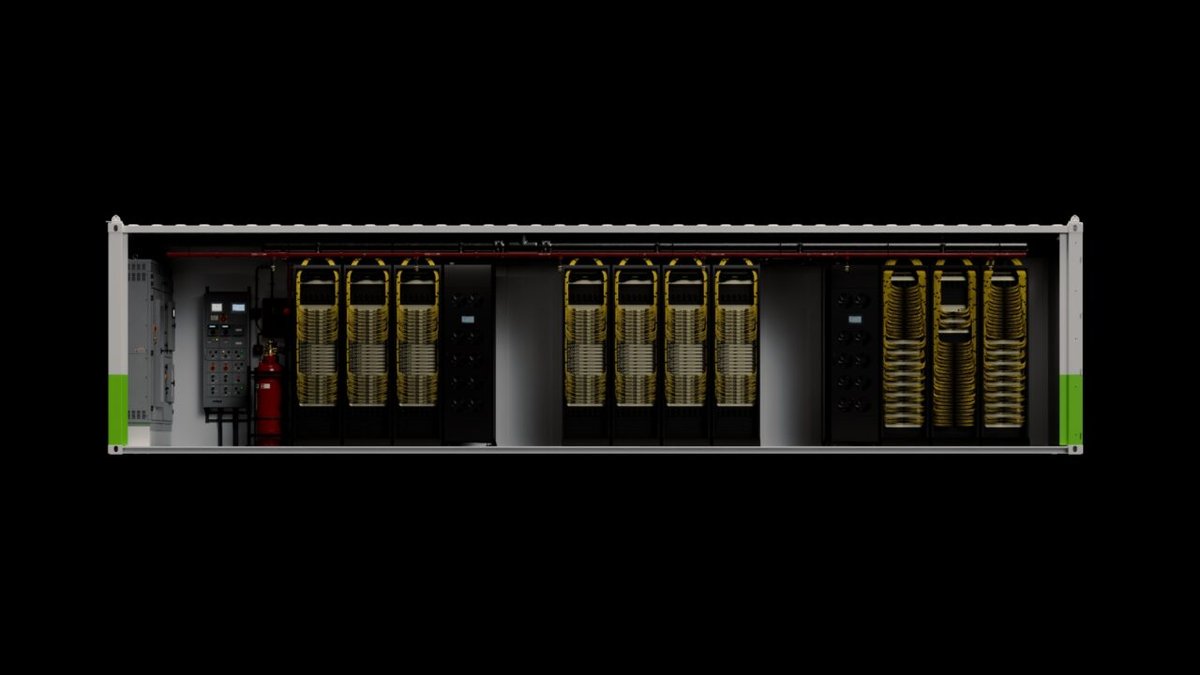
October 21, 2026 — At GTC Berlin, NVIDIA introduced DSX POD, a complete reference design that turns a Vera Rubin AI factory into standard shipping containers. Racks, cabling, piping, power distribution and liquid cooling are assembled and validated inside those containers at the factory; each container then ships to a site that needs only power, water and network to run. NVIDIA's official figure: on-site deployment falls from 6 months to as fast as 14 days.
That figure deserves scrutiny, but the direction is not in doubt. AI infrastructure competition is shifting from "whose accelerator is fastest" toward "who turns electricity into tokens sooner."
What DSX POD actually delivers: a finished factory
NVIDIA calls DSX POD the complete reference design for a Vera Rubin AI factory. Compute, networking, cabling, rack-level power and liquid cooling are integrated and functionally validated inside modular containers, then shipped as a unit. The site no longer has to handle large-scale construction, specialized labor or logistics coordination itself. It only has to be a "prepared site": power, cooling and network already in place.
First deliveries are scheduled for early 2027. The partner roster is long: Anduril, Armada, Bull, Crusoe, DayOne, Dell Technologies, Delta Electronics, Eaton, Foxconn (Ingrasys), Gigabyte, HPE, Lenovo, Pegatron, QCT, Schneider Electric, Vertiv and Wiwynn. Four of those names — Delta, Eaton, Schneider Electric, Vertiv — sell power and cooling equipment, which is itself a signal about where the bottleneck sits.
Jensen Huang's framing is that an AI factory creates value when it produces tokens, not when it is built. In procurement language: schedule is cash flow.
Dell fills in four pieces on the same day
Dell used the same day to announce four AI factory products, each mapped to a different workload:
| Model | Form factor | Key configuration | Target workload |
|---|---|---|---|
| Dell Modular Data Center (built on the NVIDIA DSX POD reference design) | Container-based | Compute, network, storage, rack power and liquid cooling integrated at the factory | Hyperscale, rapid expansion |
| PowerEdge M9882 | Rack-scale, disaggregated | Up to 256 NVIDIA Vera CPUs in one rack | Agent orchestration layer |
| PowerEdge R8822 | 2U, 2-socket, air-cooled | Two Vera CPUs, standard 19-inch rack | Pilots, reinforcement learning, analytics |
| PowerEdge XE9810 | Rack-scale inference | Dell's first NVIDIA Groq LPU-based inference platform, complements XE9812 | High-throughput, low-latency online inference |
The M9882 is the most informative of the four. It puts up to 256 NVIDIA Vera CPUs in one rack. Vera is an 88-core Arm-architecture CPU — NVIDIA calls the cores Olympus — with 1.2 TB/s of LPDDR5X memory. At 88 cores per chip, a fully populated rack works out to 22,528 CPU cores, which is arithmetic on the two published numbers (256 × 88), not a figure NVIDIA disclosed separately. This rack is not built to run models. It is built to run agents.
Why do agents need that many cores? One agent task often contains dozens of tool calls, code executions, database queries and result checks. GPUs handle model inference; CPUs handle scheduling and the actual work. That work used to ride on whatever cores were left over in GPU servers, and it stops scaling past a certain point. Dell's answer is to pull the orchestration layer into a dedicated all-CPU rack that sits beside the GPU cluster. The R8822 covers the other end: a standard 19-inch, air-cooled 2U box.

How the 14-day figure is calculated
Set the terms first. Fourteen days is not "empty lot to production." It is "equipment arrival to production, after the site is ready." In the traditional sequence, an AI data center moves from equipment delivery to live service through rack installation, cabling, piping, power commissioning, coolant fill, pressure testing and integrated testing; six months is a common figure for that stretch. DSX POD moves those steps upstream into the factory, leaving lifting, positioning, power connection, water connection, network connection and acceptance on site.
That also explains why those four vendors matter. Once a container lands, the open questions are whose power, whose cooling and whose network will be ready — and those answers decide whether 14 days holds. Schneider Electric, Vertiv, Eaton and Delta Electronics are the reason the claim is credible. The six-month baseline is also the number a buyer should hold against their own site schedule, because it is the part of the project the container does not remove.
Three takeaways
- AI factories are becoming products. Every project used to be an engineering effort; now it is a SKU. That helps buyers, because budget, schedule and acceptance criteria can be fixed before the order rather than negotiated later.
- The CPU rack is back. The "more GPUs is always better" thinking of the past two years is being corrected by agent workloads. A 256-CPU rack is an admission that orchestration compute is a real line item, not spare capacity inside a GPU node.
- "14 days" is both marketing and a filter. A 14-day go-live assumes site power, cooling source and network are all ready. Most enterprises are blocked by power, not by hardware.
What it means for Guangzhou and the Pearl River Delta
Most local companies do not need an AI factory and could not afford to build one, but the change reaches them along three paths:
- Colocation and rental get cheaper. Shorter delivery cycles speed up the supply response, and the price elasticity of renting accelerator capacity will grow.
- Server room retrofits start with the power math. Companies planning their own inference cluster should confirm existing distribution capacity and cooling headroom before selecting hardware; not every building can take liquid cooling.
- Contracts need delivery clauses. As the reference design matures, supplier commitments get more specific, and acceptance criteria, power-on dates and performance baselines can all go into the contract.
Five questions to ask before buying
- How much on-site distribution capacity is there, and can the existing UPS and diesel generators carry the added racks?
- Is the cooling air or liquid, and do floor loading and pipe routing allow the retrofit?
- Should the agent orchestration layer and the inference layer be bought separately, and if so, is the added network latency acceptable?
- From which milestone does the supplier count the "delivery cycle" — signature, arrival on site, or power-on?
- Is there a slice of early-2027 capacity with your name on it?